You asked ChatGPT about a scientific paper and it gave you a full citation — author, journal, year, volume, pages. You searched for it. It doesn't exist. Not a typo. Not a different paper. Completely fabricated. And the AI wasn't uncertain at all. It stated the citation as clearly as it states the capital of France.
This phenomenon has a name: AI hallucination. It's one of the most counterintuitive and consequential characteristics of modern AI language models, and understanding it is essential for anyone who uses AI tools for research, decision-making, or professional work.
What Exactly Is AI Hallucination?
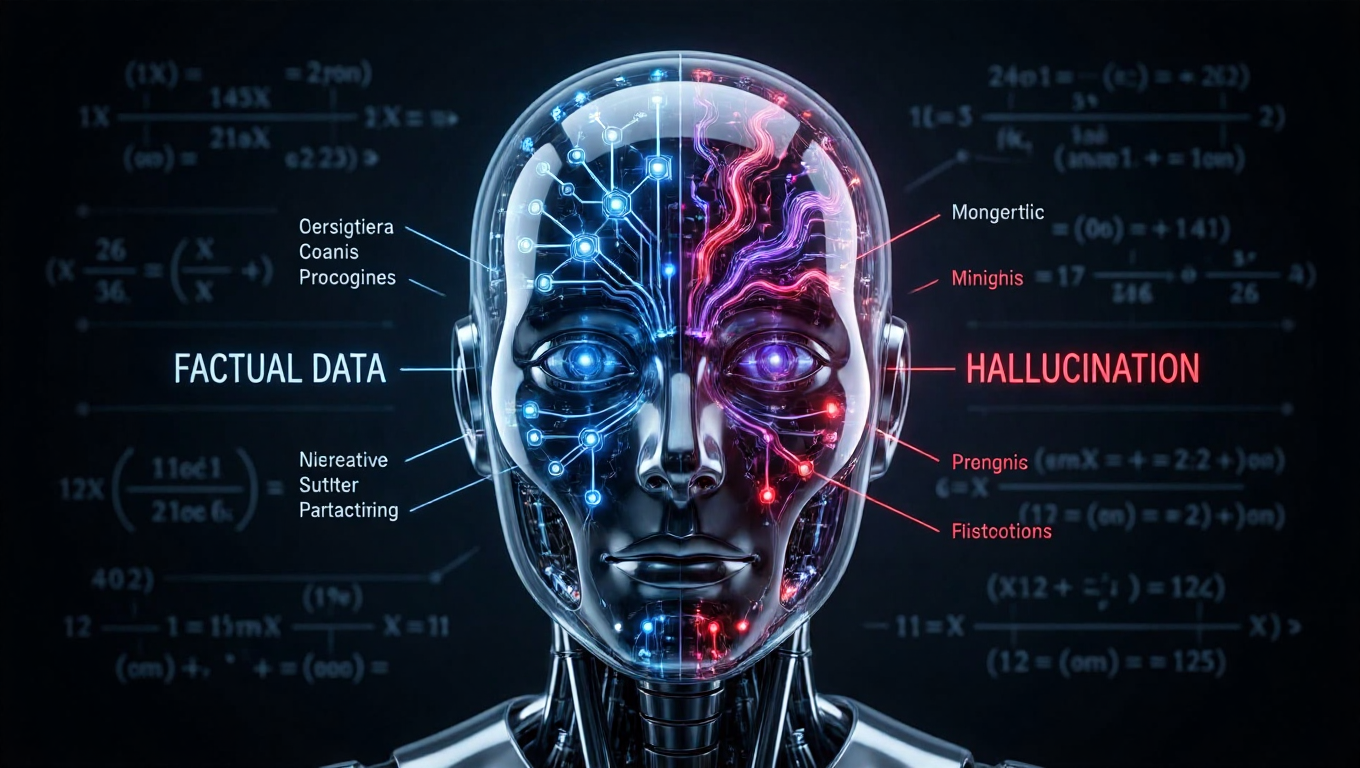
AI hallucination occurs when a language model generates information that is factually incorrect, unverifiable, or completely fabricated — while presenting it with the same confidence and fluency as accurate information. The term 'hallucination' is borrowed from psychology, where it refers to perceiving something that isn't there. In AI, it refers to generating content that has no correspondence to external reality.
Hallucinations can be subtle (a slightly wrong date or misattributed quote) or dramatic (an entirely invented research paper, a fake law, or a fabricated historical event). What makes them particularly dangerous is that they're grammatically correct, contextually plausible, and stylistically indistinguishable from accurate information.
Why Does AI Hallucinate? The Technical Reality
To understand hallucination, you need to understand what AI language models actually do. They don't retrieve facts from a database the way a search engine does. They predict the most statistically likely continuation of text based on patterns learned from vast training datasets. This prediction process doesn't inherently distinguish between accurate and inaccurate content — it optimizes for fluency and coherence, not truth.
The Core Mechanism
When you ask an AI model about a specific topic, it generates a response by selecting tokens (words and word fragments) based on their probability given everything before them. If training data contained many texts that discuss research papers about a topic, the model has learned that responses about that topic often include citations. It will generate a citation — complete with plausible-sounding author names, journal names, and years — even if that specific paper doesn't exist, because that's the pattern that fits.
The Confidence Problem
AI models don't have an internal fact-checking mechanism that triggers uncertainty when they generate false information. Their outputs reflect linguistic confidence — how likely is this word given the preceding context — not epistemic confidence — how certain are we this is true. This is why AI can state false information as definitively as true information.
When Does AI Hallucinate Most?
Research has identified several conditions that dramatically increase hallucination rates. Obscure or niche topics are high-risk because training data for them is sparse, so the model has fewer real examples to pattern-match against. Specific factual details — exact dates, precise statistics, verbatim quotes, specific citations — are high-risk because they require exact recall rather than general pattern generation. Questions about events after the model's training cutoff are extremely high-risk, as the model has no training data to draw on. And leading questions or prompts that imply a specific answer make the model more likely to generate a confirming hallucination.
Real-World Consequences of AI Hallucination
In 2023, a New York lawyer submitted a legal brief that cited several court cases generated by ChatGPT. None of those cases existed. The lawyer was sanctioned by the court. In academic settings, students submitting AI-written papers with fabricated citations have faced academic integrity consequences. In medical contexts, AI-generated health information containing subtle inaccuracies has led patients to make incorrect decisions. The stakes of unchecked AI hallucination are real and growing.
How to Detect AI Hallucinations
The Citation Test
Any time AI provides a specific citation — research paper, court case, news article, book — search for it independently before using it. Use Google Scholar, PubMed, LexisNexis, or the relevant authoritative source for your field. A real citation should be findable. An unfindable citation is almost certainly hallucinated.
The Consistency Test
Ask the same factual question in three different ways across separate conversations. If you get three consistent answers, confidence increases (though doesn't guarantee accuracy). If you get three different answers, at least two must be wrong — treat the entire topic as unverified and research it manually.
The Precision Red Flag
AI confidence is NOT correlated with accuracy. In fact, research suggests models may be more confidently wrong on obscure topics precisely because they've generated a plausible-sounding answer rather than acknowledging uncertainty. Any time AI gives you very specific figures, exact quotes, or detailed citations without acknowledging any uncertainty, apply extra skepticism.
Practical Strategies to Minimize Hallucination Impact
Use web-enabled AI tools like Perplexity AI for factual research — they pull from real current sources and link to them. Explicitly prompt the AI to acknowledge uncertainty: 'If you're not certain about any of these facts, please say so explicitly.' Use AI for tasks where hallucination doesn't matter — drafting, brainstorming, explaining concepts — and manual research for tasks where exact facts are critical. Never cite AI-generated content as a source in professional, academic, or legal documents without independent verification.
Is AI Hallucination Improving?
Yes, significantly. Models like GPT-4, Claude 3, and Gemini Ultra hallucinate considerably less than their predecessors. Techniques like Retrieval-Augmented Generation (RAG) — where models are connected to verified knowledge bases — reduce hallucination dramatically for domain-specific applications. However, hallucination has not been eliminated and likely cannot be entirely eliminated with current architectures. It remains a fundamental characteristic of language models that requires user awareness.
Conclusion
AI hallucination isn't malice or carelessness — it's an emergent consequence of how language models generate text. Understanding this helps you use AI tools more wisely. Reserve AI for tasks where absolute factual precision is less critical, and apply independent verification for everything that matters. The users who get the most value from AI are those who understand what it does well and what it fundamentally cannot be trusted to do without verification.