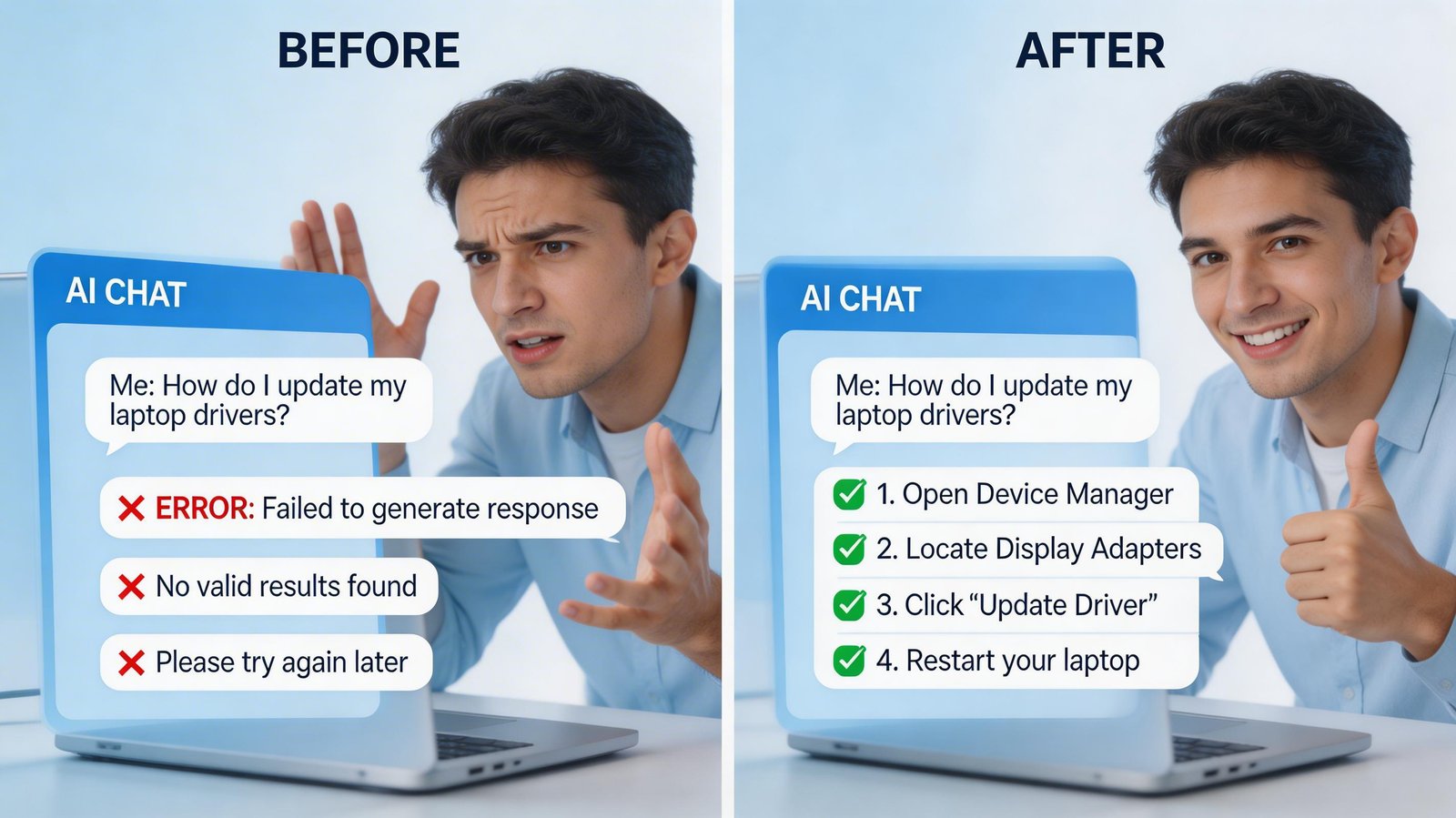
You asked your AI assistant a simple question and got a confidently wrong answer. Sound familiar? You're not alone. Millions of users worldwide deal with this daily — from ChatGPT fabricating facts to Gemini misunderstanding context. The frustrating part isn't just getting a wrong answer; it's when the AI delivers it with complete confidence, making you second-guess yourself.
The good news? Most AI accuracy problems aren't random. They follow predictable patterns, which means they have predictable solutions. In this guide, we'll walk through exactly why AI chatbots fail and give you eight battle-tested fixes you can use right now.
Understanding Why AI Chatbots Make Mistakes
Before jumping into fixes, it helps to understand the root causes. AI language models like GPT-4, Gemini, and Claude are trained on massive datasets of text. They don't 'know' facts the way a database does — instead, they predict what words should come next based on patterns they've learned. This fundamentally different approach to information is why AI can sound authoritative while being factually wrong.
There are three core failure modes: hallucination (making up plausible-sounding facts), knowledge cutoff errors (not knowing recent events), and context misunderstanding (misreading what you actually asked). Each requires a different fix.
Fix 1: Rewrite Your Prompt With Specific Details
Vague questions produce vague or wrong answers. The single most effective change you can make is to be radically specific. Instead of asking 'Tell me about diabetes,' try 'Explain the difference between Type 1 and Type 2 diabetes in terms of insulin production, typical age of onset, and treatment approaches, using simple language.' The more constraints you add, the less room the AI has to wander into inaccurate territory.
Think of it like giving directions. 'Go to the store' is useless. 'Turn left on Main Street, drive 0.3 miles, and enter the parking lot on the right' gets you there. Precision in prompting is the single highest-leverage skill in AI use.
Fix 2: Ask the AI to Think Step by Step
One of the most validated techniques in AI research is chain-of-thought prompting. Simply adding 'Think through this step by step before answering' dramatically improves accuracy, especially for math, logic, and multi-part questions. When the AI externalizes its reasoning, errors become visible and easier to catch.
For example, instead of 'What is 15% of 847?' try 'Calculate 15% of 847. Show each calculation step clearly.' You'll not only get a more accurate answer but you can verify each stage of the reasoning yourself.
Fix 3: Request Sources and Verify Them
Always ask the AI to cite its sources for factual claims. But here's the critical part — actually check those sources. AI can generate fake citations that look completely real. A study in the Journal of Immunology that doesn't exist. A quote from a professor who never said it. If the AI can't point you to a verifiable source, treat that information as unverified.
For important research, use web-enabled AI tools like Perplexity AI or ChatGPT with Browse enabled. These pull real-time information and link to actual sources, dramatically reducing hallucination on factual queries.
Fix 4: Break Complex Questions Into Smaller Parts
When you ask an AI a complex, multi-layered question, it tends to prioritize some parts and rush through others. The fix is to decompose your question into individual components. Ask them sequentially, building on each answer before moving to the next. This creates a conversational structure that keeps the AI focused and reduces the chance of critical details being skipped or fabricated.
Fix 5: Use the Same-Question-Three-Times Technique
If you're unsure about an answer, ask the same question three different ways and compare results. Rephrase it, approach from a different angle, or ask the AI to argue the opposite position. When three differently phrased questions produce consistent answers, confidence in accuracy increases significantly. When they contradict each other, that's a red flag to do manual research.
Fix 6: Provide Role and Audience Context
Telling the AI who you are and who the answer is for significantly improves relevance and accuracy. 'Explain quantum entanglement' gives generic results. 'I'm a high school physics teacher creating a worksheet for 16-year-olds with no prior quantum physics knowledge. Explain quantum entanglement in 3 paragraphs with a concrete everyday analogy' gives you something genuinely useful and targeted.
Fix 7: Use Negative Constraints
Tell the AI what NOT to do. 'Don't use jargon.' 'Don't include marketing language.' 'Don't speculate about anything you're uncertain about — if you're unsure, say so explicitly.' Negative constraints are surprisingly effective because they counteract the AI's natural tendency to be agreeable and comprehensive, which often leads to padding with inaccurate content.
Fix 8: Switch Models for Different Tasks
Not all AI models are equal at all tasks. GPT-4 excels at nuanced writing and complex reasoning. Claude is particularly strong at long document analysis and following detailed instructions. Gemini with Google Search integration is best for current events and factual lookups. Matching the right model to the right task is a practical fix that most users overlook.
When to Stop Trusting AI Entirely
For medical diagnoses, legal advice, financial decisions, and safety-critical information, no AI fix is good enough. Always consult qualified professionals. AI can be an excellent starting point for research and a powerful tool for drafting and ideation — but the final verification layer must be human for high-stakes decisions.
Building Better AI Habits
Accuracy problems with AI are largely a skill problem on the user's side, not just a technology problem. The users who get the best results treat every AI interaction as a collaboration, not a query. They iterate. They push back. They verify. They provide rich context. Developing these habits takes a few weeks but pays dividends indefinitely.
Conclusion
AI chatbots making mistakes is not a bug — it's a fundamental characteristic of how these systems work right now. But with the eight fixes outlined here, you can reduce errors dramatically and get far more value from your AI tools. Start with prompt specificity and step-by-step reasoning — they're the highest-impact changes and take less than thirty seconds to implement. Apply them to your next AI conversation and see the difference firsthand.