Every customer who has ever bought from you — online or offline — moved through some version of a sales funnel. They discovered your business, considered your offer against alternatives, decided to buy, and ideally became a repeat customer. Most businesses leave this journey entirely to chance. A deliberate sales funnel guides people through each stage intentionally.
This guide explains what a sales funnel is, why it is essential for predictable business growth, and exactly how to build one that works for your specific business.
What Is a Sales Funnel?
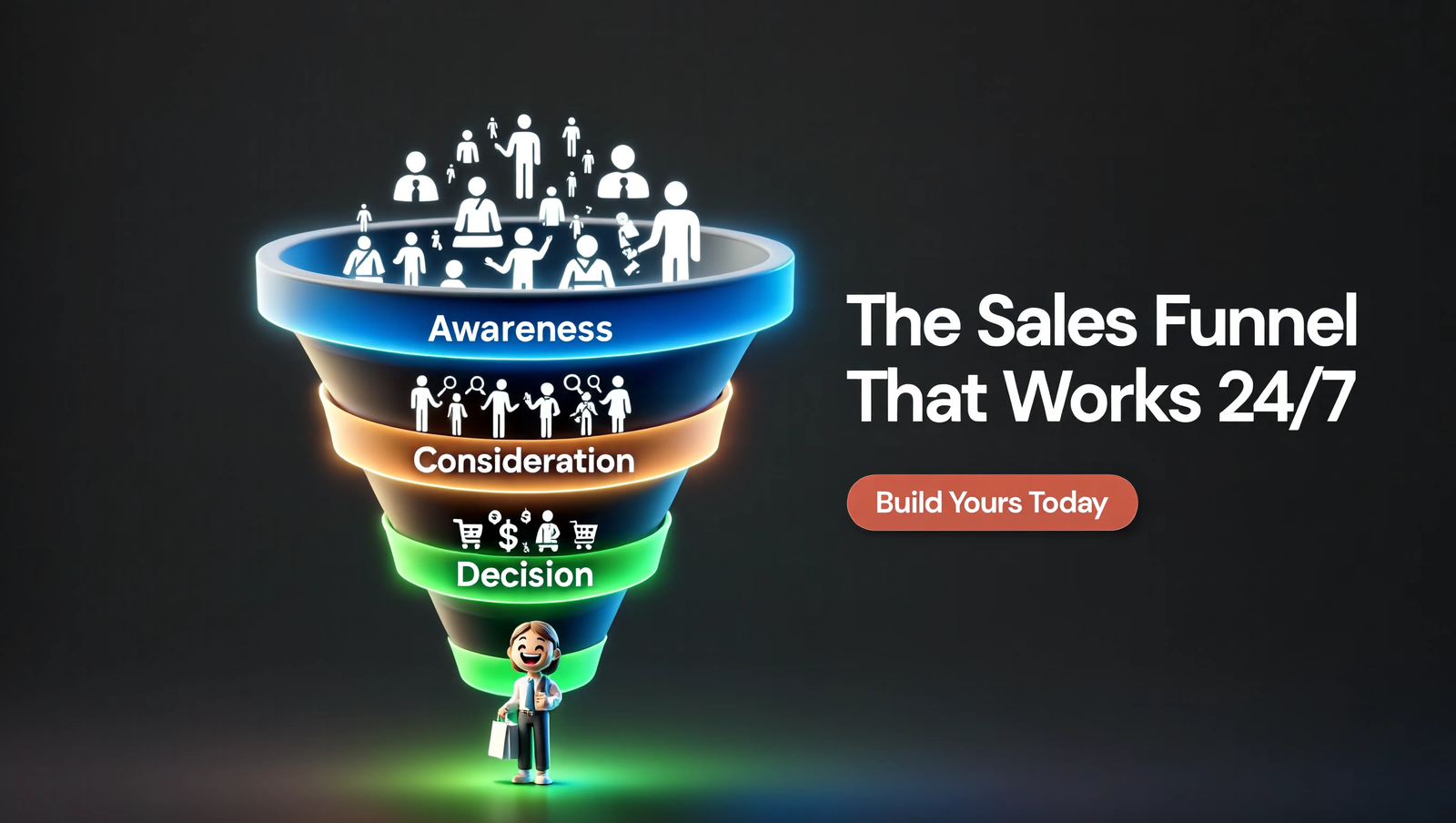
A sales funnel is the visual representation of the customer journey from first awareness of your business to purchase and beyond. It is called a funnel because many people enter at the top (awareness) and a smaller number make it to the bottom (purchase) — which is normal and expected.
The four universal stages of any sales funnel:
Awareness: the prospect discovers your business exists
Interest: the prospect engages with your content and considers your solution
Decision: the prospect evaluates your specific offer against alternatives
Action: the prospect makes a purchase
Beyond these four stages, sophisticated funnels include a Retention stage (keeping customers and encouraging repeat purchase) and an Advocacy stage (turning happy customers into referrers).
Top of Funnel (TOFU): Building Awareness
At the top of the funnel, your goal is simple: get discovered by people who have the problem your business solves. They do not know you exist yet. They may not even know a solution like yours exists.
TOFU Content and Channels
Blog posts targeting search queries ('how to fix low website traffic')
YouTube videos addressing common questions in your niche
Social media content — specifically Reels and Shorts for organic reach
Paid ads targeting cold audiences by interest or demographic
Podcast appearances on shows your target audience listens to
PR and media features
TOFU metrics: Impressions, reach, new visitors, video views. At this stage, you are not measuring sales — you are measuring discovery.
Middle of Funnel (MOFU): Building Interest and Trust
People in the middle of the funnel are aware of their problem and are actively researching solutions. They are considering you alongside competitors. Your goal here is to become the most trusted, valuable resource in their research journey.
MOFU Content and Tactics
In-depth guides, how-to articles, comparison posts ('Mailchimp vs. ConvertKit')
Email welcome sequence nurturing new subscribers
Case studies and customer success stories
Webinars or live demonstrations of your solution
Free trials or limited access to your product
Lead magnets that solve a specific aspect of their broader problem
MOFU metrics: Email open rates, content engagement time, free trial signups, webinar attendance.
Bottom of Funnel (BOFU): Converting to Customers
At the bottom of the funnel, prospects have done their research and are close to making a decision. They just need the final push — confidence that your solution is the right choice, that the price is justified, and that the risk of buying is low.
BOFU Content and Tactics
Testimonials and detailed case studies with specific results
FAQ page addressing specific objections ('Is this right for my industry?')
Comparison page ('How we compare to [competitor]')
Free consultation, demo, or audit call
Limited-time offer or bonus — creates urgency without being manipulative
Money-back guarantee — reduces perceived risk
Retargeting ads to website visitors who did not convert
BOFU metrics: Conversion rate, cost per acquisition, proposal-to-sale rate.
Building a Simple Automated Funnel: Step by Step
Create a lead magnet that solves a specific problem your ideal customer has
Build a landing page with a single focus: the lead magnet offer (no navigation, no distractions)
Set up a 5-7 email welcome sequence in your email platform (Mailchimp, Brevo, etc.)
Drive traffic to the landing page (blog content with SEO, social media, ads)
Email 1-3: deliver the lead magnet and provide additional value
Email 4-5: build deeper trust — stories, case studies, your philosophy
Email 6-7: introduce your offer — naturally positioned as the logical next step
Funnel Optimization: Finding Where People Drop Off
Every funnel has leaks — stages where people drop off in higher-than-expected numbers. Identifying and plugging leaks is the highest-ROI optimization activity.
Leak Indicators and Solutions
High landing page bounce rate: the traffic and the offer are mismatched. Test different headlines and value propositions.
Low email open rates: subject lines are weak or list is disengaged. Test different subject line styles (curiosity, direct benefit, question).
High open rate but low click rate: email content does not deliver on subject line promise, or CTA is buried/unclear.
High add-to-cart abandonment: checkout friction (too many steps, unexpected costs, no guest checkout). Simplify and add reassurance.
Low landing page conversion: offer is not compelling enough, page loads slowly, form asks for too much information.
The Retention Stage: Where Real Profit Lives
Acquiring a new customer costs 5-7x more than retaining an existing one. The retention stage of your funnel — post-purchase nurturing — is where the most profitable businesses invest heavily.
Retention Strategies
Onboarding email sequence: help new customers get maximum value from their purchase
Regular value-add communication: tips, updates, exclusive content
Loyalty or rewards program for repeat purchases
Referral program: turn happy customers into advocates
Win-back campaigns for lapsed customers
Funnel Metrics to Track
Conversion rate at each stage (visitor to lead, lead to customer, customer to repeat buyer)
Time in funnel: how long does it take the average lead to become a customer?
Cost per acquisition (CPA): total marketing spend divided by number of new customers
Customer Lifetime Value (LTV): how much revenue does the average customer generate total?
LTV:CPA ratio: should be at least 3:1 for a sustainable funnel
Conclusion
A sales funnel transforms random marketing activity into a predictable customer acquisition system. Instead of hoping the right people find your website and decide to buy, a funnel guides them deliberately through each stage of the journey. Start with a simple three-stage funnel: lead magnet, email sequence, and offer. Measure conversion at each stage. Optimize the biggest leaks first. The result is a system that generates revenue consistently, whether you are actively marketing that day or not.
Visit My Site : https://techmkit.com/blog