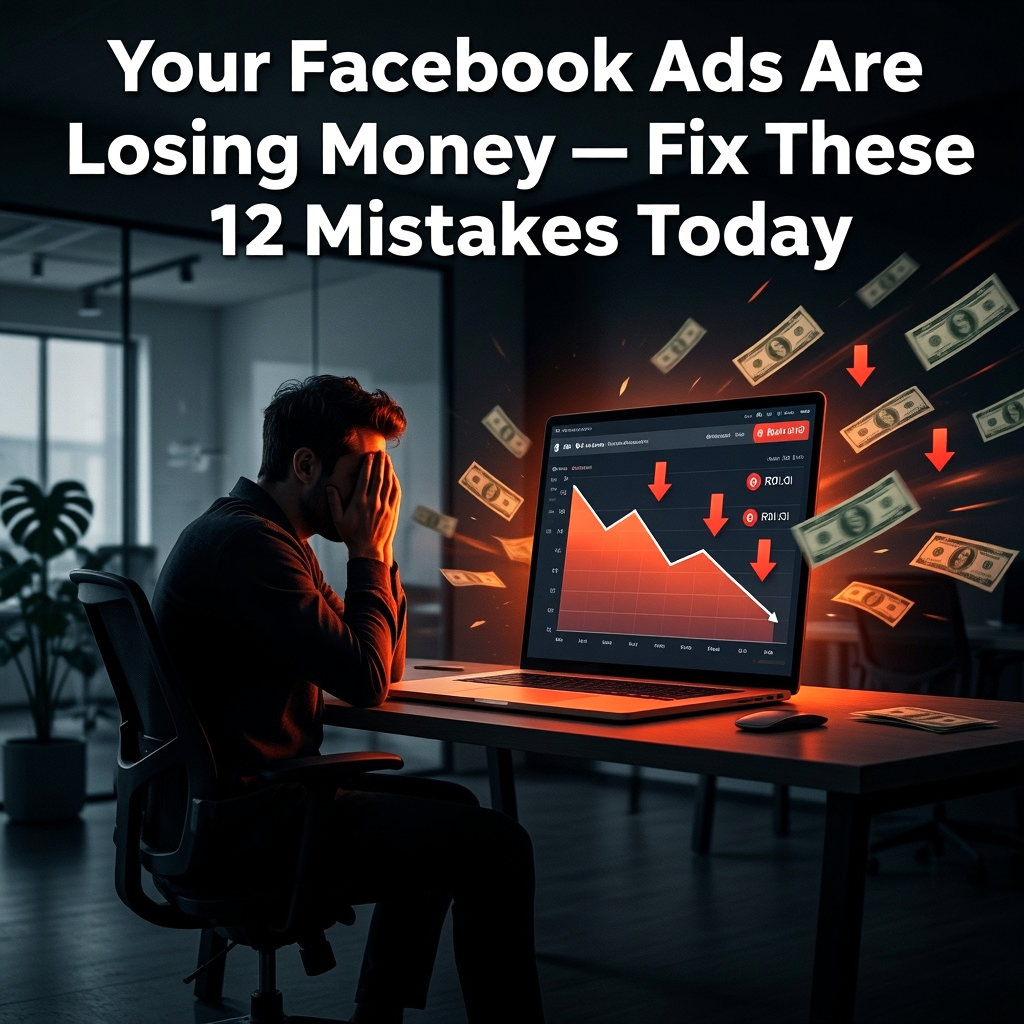
You set up a Facebook ad campaign, set a budget, hit publish, and waited for the sales, leads, or clicks to arrive. They did not. The money drained away with almost nothing to show for it. This experience is far more common than Facebook's success stories suggest — and it is almost always caused by fixable mistakes rather than the platform itself being ineffective.
Facebook advertising still delivers exceptional results for businesses that execute it correctly. The difference between campaigns that lose money and campaigns that generate 5x or 10x return on ad spend often comes down to a handful of fundamental errors. Here are the 12 most common and most costly.
Mistake 1: Targeting Everyone (Or No One Specific)
The most expensive targeting mistake is either being too broad (targeting 'all people in the US aged 18-65') or using interests that have no relationship to purchasing intent for your product. A broad audience means your budget is being spent on people with no likelihood of converting.
The Fix: Build Lookalike Audiences from your actual customer list. Upload your customer email list to Facebook Custom Audiences, then create a 1% Lookalike Audience. This tells Facebook to find people statistically similar to your existing buyers — dramatically improving relevance without guesswork.
Mistake 2: Skipping the Facebook Pixel (Or Installing It Wrong
Without the Facebook Pixel correctly installed on your website, Facebook cannot optimize your campaigns for conversions, build retargeting audiences, or track whether ads are actually producing results. Running ads without a working Pixel is like driving with your eyes closed.
The Fix: Install the Pixel through Facebook Events Manager, verify it using the Facebook Pixel Helper Chrome extension, and set up standard events: Page View, View Content, Add To Cart, Purchase. Without Purchase event data, Facebook's algorithm cannot find people who will buy.
Mistake 3: Weak or Irrelevant Creative
Facebook users scroll fast. Your ad has approximately 1.7 seconds to capture attention before they scroll past. Most failing ads use generic stock photos, unreadable text-heavy images, or creative that looks nothing like what people expect to see in their feed.
The Fix: Use video over static images when possible — video ads typically see 20-30% lower CPM than image ads. For images, use bright colors, faces showing genuine emotion, and a single clear focal point. Test at minimum three completely different creative concepts before judging what works.
Mistake 4: No Clear Call to Action
An ad that shows your product without telling people what to do next simply does not convert. 'Click here,' 'Shop now,' 'Get your free quote' — these direct, specific actions dramatically improve click-through rates compared to ads that leave the viewer wondering what to do.
The Fix: Every ad needs one specific CTA that matches the campaign objective. If the objective is lead generation, 'Get your free guide' is clear. If it is sales, 'Shop the sale — ends Sunday' creates urgency. Match the CTA button to the copy.
Mistake 5: Sending Traffic to a Poor Landing Page
Your ad can be perfect and still produce zero sales if the landing page it points to is slow, confusing, or irrelevant to what the ad promised. Facebook judges landing page experience as part of ad quality, affecting your costs.
The Fix: The landing page must deliver exactly what the ad promised — if the ad says '50% off Nike running shoes,' the page must show Nike running shoes at 50% off, not your homepage. Page load speed must be under 3 seconds. Remove all navigation links that could distract visitors from converting.
Mistake 6: Letting the Campaign Run Without Optimization
Many beginners set up a campaign and never touch it again. Facebook ad performance deteriorates rapidly without attention — creative fatigue sets in (when your audience has seen the same ad too many times), audience saturation occurs, and competitors adjust their strategies.
The Fix: Review campaigns every 3-4 days minimum. Kill ad sets with CPM above your target and zero conversions after 1,000 impressions. Refresh creative every 2-3 weeks. Scale budget (by 20% at a time, not doubling overnight) on ad sets achieving your target cost-per-result.
Mistake 7: Testing Too Many Variables Simultaneously
Running 10 different ads, 5 different audiences, and 3 different objectives at the same time fragments your budget across too many possibilities. No single variation gets enough data to be statistically meaningful, and you cannot determine what actually works.
The Fix: Follow the one-variable-at-a-time testing principle. First test audiences (same creative, different targeting). Once you find the winning audience, test creative (same audience, different images/videos). Then test offers (same creative and audience, different CTA or offer). This structured approach reveals actual causal relationships.
Mistake 8: Setting Budgets Too Low for the Learning Phase
Facebook's algorithm requires approximately 50 optimization events per week to exit the Learning Phase — the period where it experiments to find the best people to show your ad. A $5/day budget for a $100 purchase rarely generates 50 purchases per week, locking the campaign in perpetual Learning Phase.
The Fix: Budget must be proportional to your conversion value. Rule of thumb: daily budget should equal at least 5x your target cost-per-result. For a $20 cost-per-lead target, budget at minimum $100/day per ad set.
Mistake 9: Ignoring Ad Frequency
Ad frequency measures how many times the average person in your audience has seen your ad. When frequency climbs above 3-4, performance typically declines sharply — people become blind to or annoyed by repetitive ads. This is called creative fatigue.
The Fix: Monitor frequency in your Ads Manager columns. When an ad's frequency exceeds 3 and performance declines, refresh the creative immediately. For small, narrow audiences, broaden targeting or pause the ad set for 2-3 weeks before reactivating.
Mistake 10: Wrong Campaign Objective
Choosing 'Traffic' when your goal is sales, or 'Reach' when you need leads, is one of the most fundamental and expensive mistakes. Facebook optimizes your campaign for whatever objective you select, showing ads to people likely to perform that specific action.
The Fix: Match objective to business goal precisely. Selling products: Conversions (Purchase). Collecting leads: Lead Generation or Conversions (Lead event). Building awareness for a future campaign: Reach or Brand Awareness. Using Traffic for sales campaigns is particularly costly — Traffic buyers are optimized to click, not to purchase.
Mistake 11: Not Retargeting Website Visitors
Most of your website visitors will not convert on their first visit. The average e-commerce conversion rate is 2-3%. Retargeting — showing ads specifically to people who visited your website or engaged with your social content — targets people who already showed interest, typically converting at 3-5x higher rates than cold audiences.
The Fix: Set up retargeting campaigns targeting Website Visitors (all visitors in last 30 days), Product Page Viewers (showed interest in specific products), and Add to Cart Abandoners (highest intent). Use different messaging for each group based on where they dropped off.
Mistake 12: Making Budget Decisions Based on Too Little Data
Killing a campaign after $20 of spend with zero results, or scaling a campaign to $500/day after one good day, are both expensive errors. Statistical significance requires sufficient data before making meaningful decisions.
The Fix: Allow each ad set to spend at least 3x your target cost-per-result before evaluating. For a $30 target CPA, let the ad set spend $90 before judging. Do not scale campaigns that have not consistently performed for 5-7 days.
The Compound Effect: Fixing All 12 Together
These mistakes compound each other. Wrong objective + weak creative + low budget + poor landing page = guaranteed failure. Fixing any one of them improves results incrementally. Fixing all of them transforms campaigns from money-losing experiments to reliable growth channels.
Start with Mistakes 2, 5, and 10 — Pixel installation, landing page relevance, and correct objective selection. These have the highest individual impact and take the least time to fix. Then work through creative, targeting, and optimization systematically.
Conclusion
Facebook advertising works. But it requires correct execution, not just budget. Businesses that treat it as a vending machine (put money in, get sales out) consistently fail. Businesses that treat it as a system to be tested, measured, and optimized consistently succeed. Address these 12 mistakes one by one and your results will begin to improve within days.
Learn More......................